Mobile apps
App or website for your business? How to decide without overspending
When a website is enough, when an iOS and Android app is worth it and what an installable website is. Practical criteria and five questions to answer before you ask for a quote.
Many people ask for an app when what they need is for customers to book without phoning. Others stay with a website when their customers already come back every week and would welcome having it on their phone. The useful question is not what is fashionable, but what your customer does and how often.
1. A website is what people find first
People who do not know you search on Google, not in an app store. A website opens from a link, there is nothing to install and it works on any phone and computer. And a change goes live straight away.
If most of your visitors arrive only once or very occasionally, a well-made website is usually enough: a restaurant serving tourists, a professional office, a renovation company. If you already have one, our free website checkup will tell you where to start improving it.
2. When an app is worth it
An app wins when the same customer comes back again and again, or when you need something a phone does better than a web page:
- Frequent use. A yoga studio where each student books several times a month, or a bakery where people order every day.
- Notifications. A reminder of an appointment, news of a free place or a message that the order is ready.
- Phone features. Camera, QR code, location or working offline.
- Tools for your team. Work reports, stock or time clocking: nobody has to go looking for it, and it lives on the company phone.
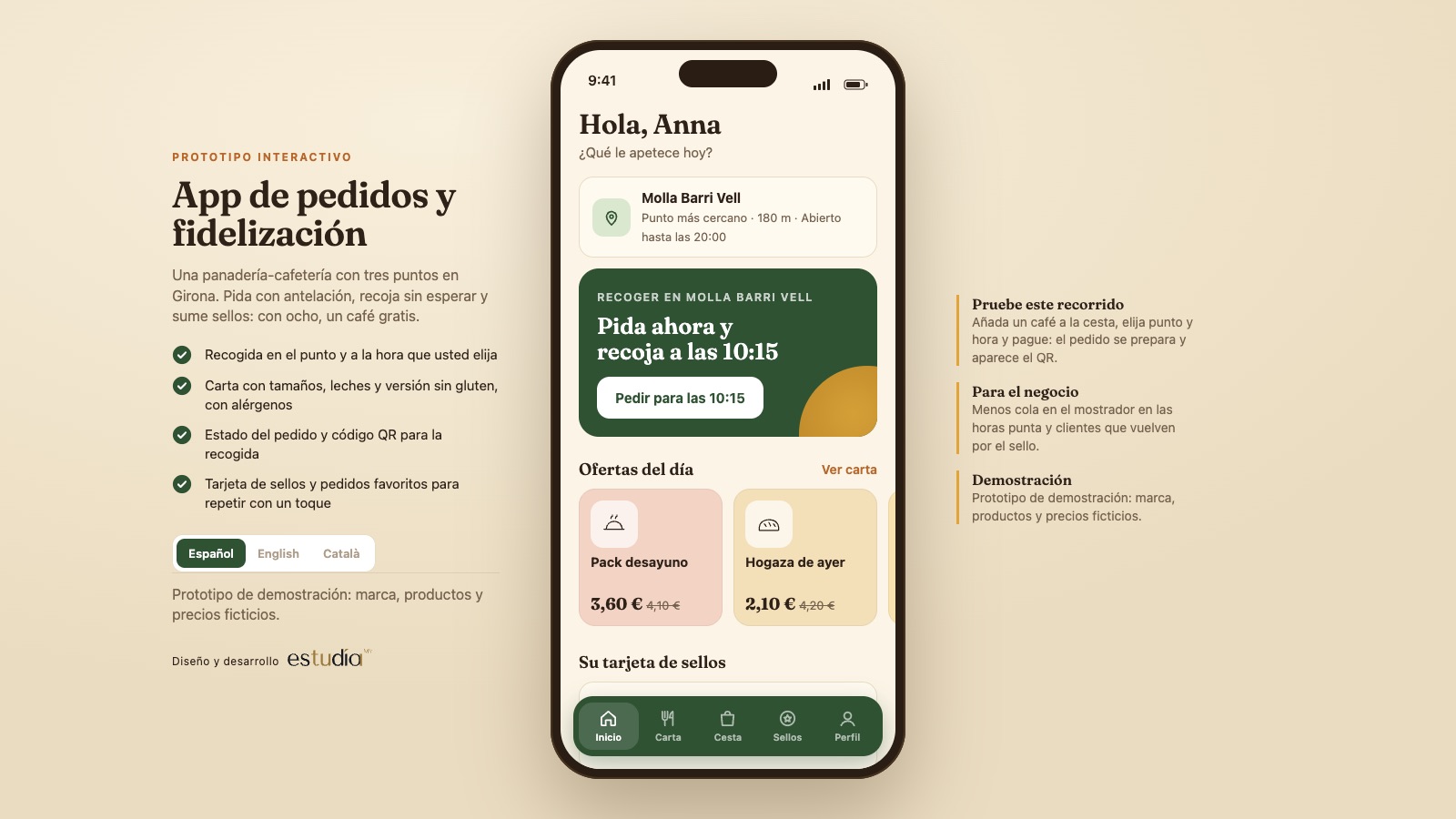
We show this in two demonstration projects, with a fictional brand and data: Onda, bookings and passes for a pilates studio, and Molla, pick-up orders and a stamp card for a bakery.
3. The middle ground: a website you can install
An installable website (what technical people call a PWA) opens like a website, but it can be added to the home screen and opened full screen, like an app. It does not go through any store review and it updates like any other website.
It can also send notifications. On iPhone, according to Apple’s documentation, web notifications work from iOS 16.4 on websites added to the home screen: the customer has to take that step first, and not everybody does.
It is a good way to test an idea before investing in an app. What it does not give you by itself is a presence on the App Store and Google Play.
4. If it is an app: native or a single codebase
There are two routes. A native app is written separately for each system; on iOS, with Swift. It is the natural choice if it relies heavily on iPhone features or if iOS is all you care about.
With a single codebase, for example Flutter, the same app serves iOS and Android. It is usually the sensible option for a business whose customers use both systems. We decide by looking at who your customers are, not out of habit.
5. What people tend to forget when budgeting
- Developer accounts. Apple and Google charge for a developer account. Check the current amount and open it in your company’s name, so that the app is yours.
- Store review. Every version goes through a review, and sometimes it is rejected and something has to be fixed. Allow for this in your dates.
- Maintenance. Each new version of iOS and Android may call for adjustments. An app is not finished on the day it is published.
- Your customers’ data. The stores ask you to declare what data the app collects, and the GDPR applies just as it does on a website.
- Getting it installed. Nobody finds a local business’s app by chance: you need your website, your premises and your customers to make it known.
6. Five questions to decide
- How many times a month does the same customer come back? If only a few, start with the website.
- Do you need notifications, the camera, QR codes or offline work? If so, think about an app or an installable website.
- Do people mainly find you on Google? Then the website comes first, with or without an app.
- Is it a tool for your team? An internal app carries little risk: nobody has to be persuaded to install it.
- Can you test the idea with a prototype? Almost always, and it costs far less than getting it wrong.
For most businesses the order is this: first a website that works, and the app when customers are already asking for it. If you want to look at it with your own case in front of you, we start with a prototype you can tap on a phone. And if your business is nearby, you can also read what we take into account in apps for businesses in Girona.